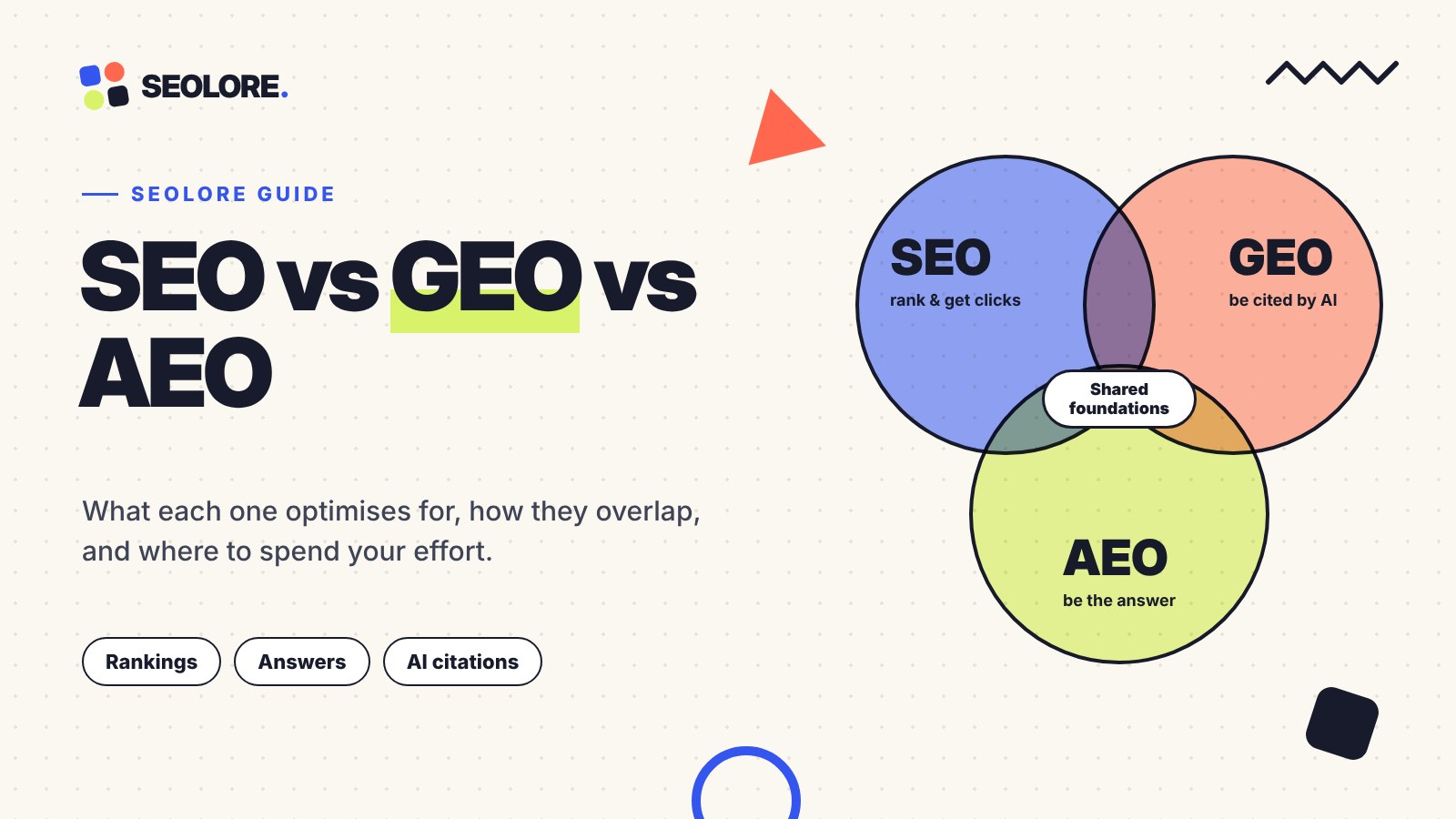
Short answer: SEO (search engine optimisation) gets your pages ranked and clicked in search results. GEO (generative engine optimisation) aims to get your brand and content cited inside AI-generated answers from tools like ChatGPT, Perplexity, Gemini and Google's AI Overviews. AEO (answer engine optimisation) sits between the two: it shapes content so a system can lift a direct answer from it. They overlap far more than the acronyms suggest, and for Google's own AI features, Google says the work is still SEO.
What is GEO vs SEO?
SEO is the practice of making a site easy to crawl, index and understand, then earning a place in the ranked list of results. Success means rankings, clicks and conversions from organic search.
GEO started as an academic term. A 2023 paper, GEO: Generative Engine Optimization (accepted to KDD 2024), studied how content changes affect whether a source shows up in AI-generated answers. On the authors' own benchmark, some methods raised visibility by up to 40%, and results varied by topic. That is a lab finding, not a promise for any one site.
In marketing, GEO now usually means: being the source an AI answer quotes, links or recommends when someone asks about your category.
One naming trap: some people still use "geo" for geographic targeting (local and international SEO). If that is what you are after, see our guides to local SEO and international SEO. In this article, GEO means generative engine optimisation.
SEO vs AEO vs GEO (and AIO, LLMO)
The search volume shows people are confused by the alphabet soup, so here it is in one table.
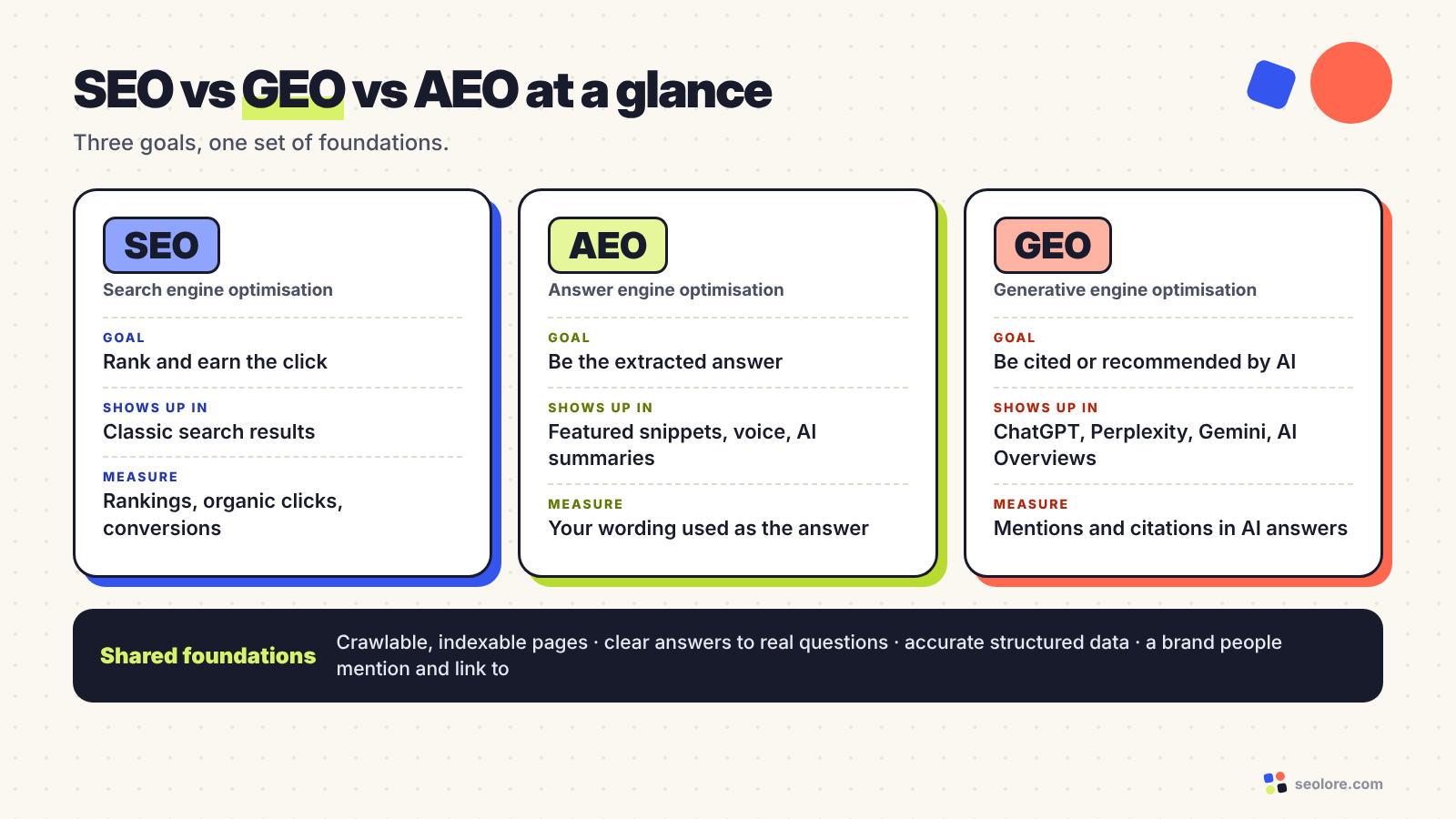
| Term | Stands for | Goal | Where it shows up | Main signal of success |
|---|---|---|---|---|
| SEO | Search engine optimisation | Rank and earn the click | Classic search results | Rankings, organic clicks, conversions |
| AEO | Answer engine optimisation | Be the extracted answer | Featured snippets, voice answers, AI summaries | Your wording used as the answer |
| GEO | Generative engine optimisation | Be cited or recommended by AI | ChatGPT, Perplexity, Gemini, Copilot, AI Overviews | Mentions and citations in AI answers |
| AIO / LLMO | AI optimisation / large language model optimisation | Same idea as GEO under another name | AI assistants | Same as GEO |
AIO and LLMO are mostly other labels for GEO. If an agency sells them as separate services, ask what actually changes in the work.
What changes and what stays the same
Most of the work is shared. A page that is slow, blocked from crawling, thin or vague does poorly in search results and in AI answers alike.
What stays the same:
- Crawlable, indexable pages with clean technical foundations.
- Content that answers a real question better than the alternatives.
- Clear structure: descriptive headings, short direct answers, then the detail.
- Accurate structured data that matches what is visible on the page.
- A brand people talk about and link to.
What GEO adds on top:
- Answer-first writing. Put the direct answer near the top, in plain sentences that still make sense when quoted on their own.
- Citable facts. Specific numbers, dates, definitions and named sources give an AI system something concrete to quote. Vague claims give it nothing.
- Consistent entity details. Your name, what you do, where you operate and who you serve should read the same on your site, profiles and directories.
- Presence beyond your own site. AI answers often lean on reviews, comparisons, forums and press. Being mentioned in credible places matters more here than in classic ranking.
- Different measurement. You track whether, how and how accurately AI tools describe you, not only where a page ranks.
What Google says about GEO and SEO
This is where much of the "SEO vs GEO" debate gets simpler. For Google's own AI features, Google's guidance is direct:
- Its AI optimisation guide answers the question of whether optimising for AI search is still SEO with "In short, yes!"
- Its page on AI features and your website says there are "no additional requirements to appear in AI Overviews or AI Mode". A page needs to be indexed and eligible to show with a snippet.
- Google says you don't need special AI files, markup or Markdown, and that an llms.txt file will neither help nor harm your visibility in Google Search.
- Traffic from AI Overviews and AI Mode is reported inside the normal Performance report in Search Console, under the Web search type.
So for Google, good SEO is the GEO work. Other AI assistants use their own retrieval and their own sources, which is why brand mentions and third-party coverage carry extra weight outside Google.
SEO vs GEO: the business impact
Ranking and being cited lead to different outcomes, and it helps to be honest about both.
- Clicks. A ranking earns a visit. An AI answer may resolve the question with no visit at all, so some informational traffic will fall even when your content is used.
- Influence. Being named in an AI answer shapes shortlists before anyone reaches your site. Buyers who arrive later often know your name already.
- Accuracy risk. AI tools can describe you wrongly: old prices, the wrong services, a competitor's features. Checking what they say about you is now part of brand care.
- Budget. You rarely need a separate GEO budget. Most of the spend goes on the same technical work, content and PR that SEO already needs, with a small extra slice for AI visibility tracking.
Do you need a GEO agency or an SEO agency?
For most businesses, a capable SEO team that understands AI search is enough. Be wary of anyone who:
- Guarantees placement in ChatGPT or Google AI Overviews. Nobody controls that.
- Sells llms.txt files, special "AI schema" or hidden prompts as a ranking fix.
- Cannot explain how they will measure citations, or which tools and prompts they will track.
Good questions to ask: which queries and AI tools will you monitor, how often, and how will you separate AI-driven changes from normal ranking movement?
SEO vs GEO for small businesses
If you have limited time, do this in order:
- Fix the basics first: indexing, speed, mobile usability and clear page titles. A free SEO audit will show the main gaps.
- Rewrite your key service pages so the first paragraph answers "what do you do, for whom, where, and at what price range".
- Add an FAQ section to the pages people ask about most, with short, factual answers.
- Keep your business details identical on your site, Google Business Profile and the main directories.
- Collect genuine reviews and get mentioned by local press, partners or trade bodies.
- Once a month, ask two or three AI tools the questions your customers ask, and note whether you appear and whether the details are right.
How to measure SEO and GEO
| What to track | SEO | GEO |
|---|---|---|
| Visibility | Rankings for target queries | Share of AI answers that mention or cite you |
| Traffic | Organic clicks in Search Console | Referrals from AI tools in analytics, plus Search Console (AI Overviews sit inside Web) |
| Quality | Conversions from organic visits | Accuracy of what AI tools say about you |
| Coverage | Indexed pages and query coverage | Which prompts and topics you appear for |
Keep a fixed set of prompts, run them on a schedule and record the results. AI answers vary from one run to the next, so look for trends over weeks rather than reacting to a single answer.
Common myths
- "SEO is dead, GEO replaces it." AI features are built on search indexes and ranking systems. Weak SEO usually means weak GEO.
- "You need an llms.txt file to appear in AI answers." Google says it does not use it for Search. Other tools vary, and none publish it as a requirement.
- "Schema markup gets you into AI Overviews." Structured data helps systems understand a page, but Google lists no special markup for its AI features, and markup must match visible content.
- "GEO results can be guaranteed." No one can promise citations or placements in AI answers.
Frequently asked questions
What is the difference between GEO and SEO? SEO aims to rank pages in search results and win clicks. GEO aims to get your brand and content cited in AI-generated answers. They share most of the same groundwork.
Is GEO replacing SEO? No. AI answers draw on indexed, well-structured, trusted content, which is what SEO builds. GEO adds answer-first writing, citable facts, brand mentions and AI visibility tracking.
What is the difference between SEO, AEO and GEO? SEO targets rankings, AEO targets being the extracted answer, and GEO targets being cited or recommended in generative AI answers.
Does Google require anything special for AI Overviews? No. Google says there are no additional requirements beyond being indexed and eligible to show with a snippet.
Do small businesses need GEO? They need sound SEO, clear answers on key pages, consistent business details and genuine reviews. That covers most of what GEO asks for.
Where to go next
Read our guides to generative engine optimisation, answer engine optimisation and AI search visibility, or see how we approach GEO, AEO and AI search. To check the foundations first, run a free SEO audit. No one can guarantee rankings or AI citations, and we won't claim to.